For this week’s post I would like
to talk about a conversation that I witnessed this weekend. For confidentiality
reasons I will not give any names. It is not uncommon (to me) to see
internalized racism. It is also not uncommon for minority groups to have racists
or discriminatory remarks about another minority group. I would like to write
about this experience in a form of a story.
I sat in
the kitchen table, as we were finishing our dinner the topic of Chicago violence
arose. I was interested in knowing where this conversation would lead. Two
middle aged Hispanic males began the conversation about the most recent crime
that occurred in the south side of Chicago. A family of six had been murdered
in their home and their seemed to be no signs of forced entry. One of them
suggested that they were probably part of the Mexican Cartel and that the Cartel
had been the one that had ordered the kill. The other male joined and mentioned
how he had heard that the father, who was not murdered, had been the one to
call the hit on his family. At that point, the wife of one of the males joined in
disbelief that someone could not do that to their own family, but quickly
withdrew her statement after acknowledging that there are “sick” people out
there. It was at this point that the conversation soon turned to police
violence and African American people. One of the males stated with confidence “they
[African American] are the worst, why do you think so many of them are in jails
and prison because they commit the most crimes! Latinos are also right up there
and they also commit a lot of crimes. But of all the races those two are the
ones that are incarcerated. But the Blacks are the worst and they are lazy”. It
was here that I immediately wanted to interrupt and say that there was a reason
why minority groups, especially Latino and African American populations, were
the ones that fill up our jails. But I didn’t, because I knew that would not
get me anywhere, they would end up using circular logic to make their point. They
often turned to the young female next to me asking for validation “isn’t it
true though, they commit the most crimes that is why they are in prison”. Now
coming to think about it was more of a rhetorical question. The young women
next to me didn’t know how to respond. Just like me she knew that was not the
case, but didn’t want to enter an argument because she knew she would not get
her point across. Instead, she instead
nervously laughed and shrugged her shoulders. They began to discuss recent
police brutality cases and stated that if they—the victims of police brutality—would
have stayed out of trouble they wouldn’t have gotten stopped/frisked. In other
words, it was their fault for being criminals. Once again I had to “bite my tongue”
not to say anything this time because I wanted to see how this conversation
would continue. I wanted to continue to be an observer and not engage in the
conversation.
They began
to talk about the news and how every single time they watched the news, there
is some Black guy that has committed a crime. Once again they used this
statement as evidence that the majority of African Americans were criminals. After
all, they were in jail and they committed the most crimes as reported in the
news therefore they were the worst. One of the older women responded by saying
that some people do deserve what was coming to them. The police have every right
to do what is necessary especially when the “criminal” is resisting, and they
have a weapon. The public shouldn’t be like “oh poor them they were treated injustly”.
One of the males agreed and reinforced
that sentiment stating, “parents
should be educating their kids not to be criminals and to cooperate with the
police if they ever get stopped instead of protesting and striking for Black Lives Matter and questioning ‘why
did they do that to so and so?” They agreed that unless the individual had been truly defenseless then yes, it
deserved attention. However, I know that police brutality is present and in
most cases than not the presumed “criminal” –especially if a person of color—will
be treated with disrespect and often beaten and abused. This seemed to be the
final consensus of the conversation, “they deserve to be punished if they are “bad”.
Therefore, they should not do “bad” things so the police doesn’t have a reason
to look for them”.
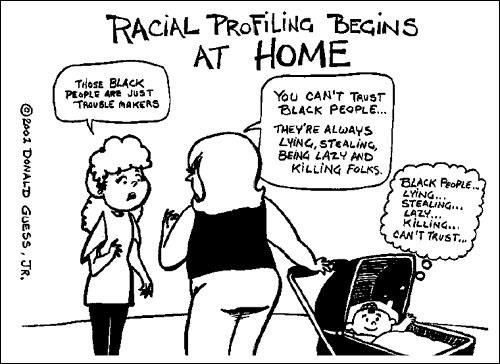
It was very interesting to sit as an outsider to this
conversation. From what I have learned in class I could have dismantled their
arguments. But also taking into account their age and years of ingrained imagery
of African Americans, the media, and internalized racism I knew my word would not
get far and I felt somewhat powerless. It was a weird sensation of felling
empowered by all the knowledge and powerless of changing someone’s opinions. I
wondered if would have at least gotten them to understand my perspective, even
if they didn’t truly by into my explanation had I spoken up and participated the
conversation. It was clear that Latinos and African American (particularly African
Americans) were profiled criminals.
Side Note: There was a point in the conversation when one of the
males was very sure—almost as if he had
read it as a statistic somewhere—that African Americans and Latinos were the
ones who sold ALL the drugs. He was certain that almost every drug dealer is
African American or Latino as well as the ones that consumed the most drugs. In
my observation this opinion is heavily influenced by media and T.V shows. Shows
like hours, Criminal minds and Mexican soap operas tend to portray dark
skinned and African Americans as criminals. It is something that has been
ingrained and part of their values and to some extent part of the culture’s values.

WOW. What a story. I know this feeling so well. Knowing that you have things to contribute to the conversation but not feeling like you will be heard or taken seriously. I think that both age and gender play a role here. Being a younger woman in a family automatically sidelines you in some conversations. When I try to interject into these types of conversations, I often get comments like, "Well, you haven't been around as long as I have" or "You haven't experienced such and such thing." I usually end up getting really mad and then I can be written off as hysterical or overly emotional. Speaking up when empowered with a different kind of knowledge is something that I am continually working on.
ReplyDelete